
Overweight Dogs: What the Research Says About Diet and Body Condition
If you know me in real life, you'll know that overweight and obese dogs are my pet hate. Not because I'm judging anyone, but because I feel so incredibly sorry for the dogs.
It's almost never their fault. And it's usually not their owners' fault either. Most of the time it comes down to misguided information about how much to feed, and what to feed.
So in this post I'm sharing what the research says, including a new study on diet and body condition, plus an easy way to check your own dog in five minutes.
How common are overweight and obese dogs?
Studies from around the world suggest that up to 6 in 10 pet dogs are overweight or obese, depending on who is being studied.
USA: around 60%, based on almost 5 million dogs seen at vet clinics
Japan: about 55%, from 9,120 dogs at 1,198 clinics
Australia: about 41%, from a study of Australian vet practices
New Zealand: just over 28%, from North Island vet clinic records
Countries use different methods, so treat these as a ballpark rather than a league table. Our NZ figure comes from vaccination visit records, so it may not reflect every dog in the country.
Why a healthy weight matters for your dog's health and lifespan
Body fat isn't just stored energy. It's biologically active tissue. Too much of it is linked to chronic low-grade inflammation, extra strain on joints, poorer metabolic health and insulin sensitivity, and a lower quality of life. It's also been linked to shorter lives.
The Labrador diet restriction trial
In a long-running Labrador trial, dogs fed 25% less for life stayed lean and lived a median of 1.8 years longer (13.0 vs 11.2 years). The lean dogs averaged 4.6 out of 9 on the body condition scale, against 6.7 for the dogs fed freely. That's ideal, not skinny. They also needed treatment for chronic conditions, especially arthritis, about two years later. There's a good summary of the trial in the British Journal of Nutrition.
The 50,000 dog lifespan study
In a study of records for around 50,000 neutered dogs across 12 breeds, dogs who were heavy through middle age lived shorter lives in every breed, by anywhere from about 5 months to 2.5 years. It can't prove cause and effect, but it points the same way.
Which dogs are most at risk of being overweight?
Any dog can put on weight, but some are more likely to.
Age: in that US dataset, about 26% of young adults were overweight or obese. That rose to about 63% in mature dogs and 58% in seniors. Japanese data shows risk peaking around 7 to 9 years.
Breed: in UK vet records, Pugs had about three times the odds of being recorded as overweight compared with crossbreeds, and Beagles about 2.7 times. Vets underrecord weight problems, so the real picture is likely worse.
Sex and desexing: the Japanese data linked being female with higher obesity risk, and desexed dogs with higher overweight rates in several size groups.
Awareness: in a survey across ten European countries, owners who didn't see obesity as a disease were more likely to have obese dogs. It's hard to fix something nobody has told you is a problem.

New research: raw vs commercial dog food and body condition
This year, German researchers published a study comparing 104 healthy adult dogs that had been fed exclusively either a raw meat-based diet (51 dogs) or a commercial complete diet (53 dogs) for at least 12 months. A vet scored every dog on the 9-point body condition scale.
What the German study found
Raw-fed dogs had a median body condition score of 5 out of 9, which is ideal.
Commercially fed dogs had a median of 6 out of 9, which is in the overweight range.
Body weights were similar, around 25 kg in both groups. The difference was in body fat, not the number on the scales.
Raw-fed dogs ate about 89% of their estimated daily energy needs. The commercial group ate about 102%.
About 46% of the commercial diets' energy came from carbohydrate. In the raw diets, protein made up about 54% of the energy, and carbohydrate was very low.
Why were the raw-fed dogs leaner?
Calories are one obvious suspect, and diet composition may play a part too. Higher protein diets are often used in weight loss plans for dogs, partly because protein helps hold on to lean muscle while fat comes off. Higher carbohydrate meals also raise blood glucose more than high protein and fat meals.
A separate Finnish study of 46 Staffordshire Bull Terriers found something similar. Over about 4.5 months, dogs on kibble showed higher long-term blood sugar, blood fats and bodyweight. The raw-fed dogs showed lower blood sugar and blood fats. There's also a University of Helsinki summary of that one.
The fine print on raw vs commercial diets
I'd rather you hear it from me:
These were small studies, and owners chose their own diets. They can't prove raw feeding made the dogs leaner. Raw feeders may also be more hands-on with portions.
In the Finnish study, the diets differed in fat, carbs and processing all at once, so it's hard to pin the effect on any one thing.
Vet nutritionists at the University of Guelph point out that dogs gain weight when calories in exceed calories out, whatever the source. The evidence that carbs alone cause fat gain in dogs is mixed.
The German study also found the raw rations fell short on some minerals. The calcium to phosphorus ratio (median 1.0) was below the recommended minimum of 1.1, and blood levels of iodine, copper, zinc and manganese were lower than in the commercially fed dogs. No dog showed signs of deficiency, but the authors say it needs more research.
My takeaway: you don't need to switch to raw to keep your dog lean. What matters is what's in the bowl (protein, fat and carbs), how much your dog actually eats, and how your dog looks and feels as a result. And if you do feed raw, it needs to be properly balanced.
Dog weight and gut health
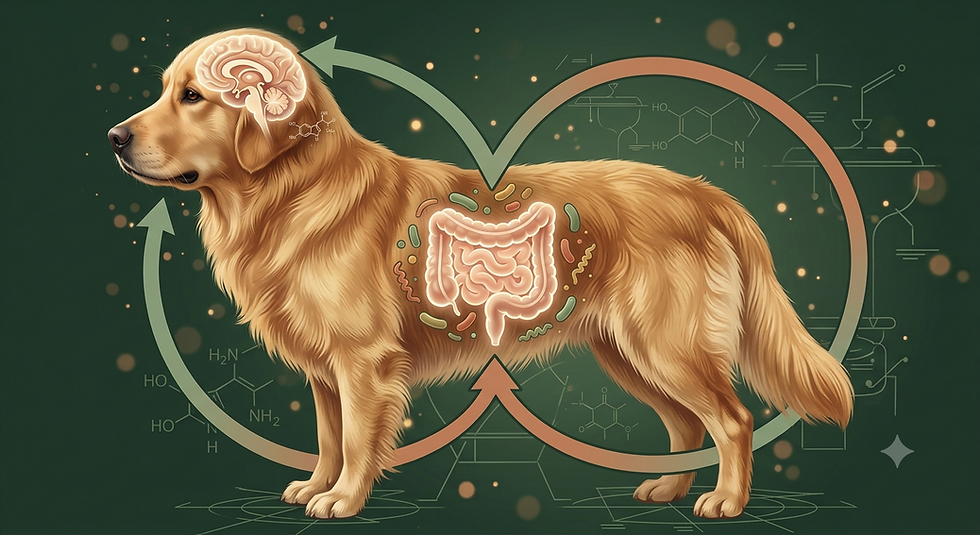
If you know me, you know I think gut health sits at the centre of most things. There's a link here too.
In a controlled trial of 63 Labradors and Beagles, both lean and obese, dogs ate either a high protein, low carb diet or a lower protein, higher carb diet for four weeks. The makeup of their gut bacteria shifted with the diet, and the effect was stronger in the obese dogs.
It's a short study, and it doesn't show that gut bacteria cause weight gain. But it's a good reminder that food does more than deliver calories.
What is a healthy body condition score for dogs?

Vets score body condition from 1 to 9.
1 to 3: too thin
4 to 5: ideal
6 to 7: overweight
8 to 9: obese
An ideal dog has ribs you can feel easily under a thin layer of padding, a visible waist when you look from above, and a gentle tuck-up at the tummy from the side. If you have to hunt for the ribs, or your dog looks like a sausage from above, it's time to look closer.
Four dog weight myths worth busting
"He's just big-boned." Bone structure doesn't hide fat. Go by the rib test, not the label.
"Chubby dogs are happy dogs." Extra weight is linked to a lower quality of life and, in studies, a shorter one.
"Kibble makes dogs fat." Calories make dogs fat, and portions are easy to get wrong. In a University of Guelph study, owners measuring kibble with cups and scoops were out by anywhere from 48% under to 152% over.
"Raw-fed dogs are always lean." One study found that group leaner on average. It's not a guarantee for every dog.
How to check if your dog is overweight in 5 minutes
Feel the ribs. You should find them easily without pressing hard.
Look from above and the side. Check for a waist and a tuck-up.
Weigh the food. Kitchen scales beat cups and scoops.
Add up the extras. Treats, chews and scraps all count.
Take a photo. Same spot, same angle, once a month. It makes small changes easy to see.
Need help with your dog's diet?
If you'd like help working out a balanced plan for your dog, whether that's raw, cooked, kibble or a mix, get in touch. No pressure at all.
This post is general information and isn't a substitute for advice from your vet. If you're worried about your dog's weight or health, please check in with them first.


Comments